
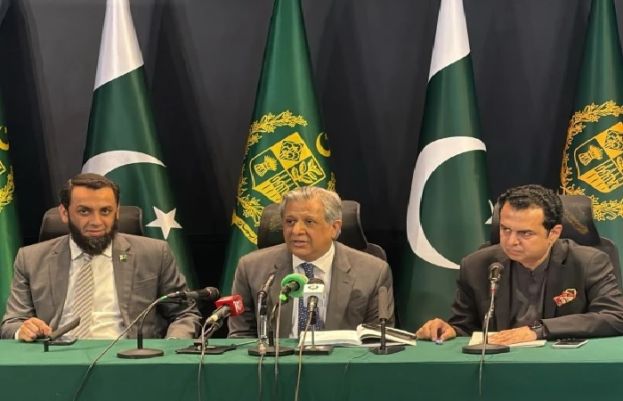
He made the remarks while addressing a press conference alongside Information Minister Ataullah Tarar and Minister of State for Interior Tallal Chaudry.
The press conference came against the backdrop of conflict in Iran, which has been embroiled in a war with the United States and Israel since the latter’s February 28 strikes, prompting retaliatory strikes from Iran on neighbouring countries, which house US bases.
Taking note of the recent escalation in the Middle East following US-Israeli attacks on Iran, the minister stressed the need for caution in the “narrative on these matters on social media, electronic media, and print media”.
“As a nation, we must keep in mind that when expressing our views, we have to keep the constitution and Pakistan’s foreign policy under consideration,” he said.
He added that the analyses coming out of Pakistan had caused “unease on diplomatic fronts from at least a friendly country or some other corner”.
“We have been asked if this was Pakistan’s stance or an individual one,” he added.
At the outset of the press conference, the minister reiterated Pakistan’s stance on the tensions in the Middle East, stating that the country had been pushing for efforts to “find a diplomatic solution” to the conflict.
In light of the prevailing situation, the minister urged the need to be careful in the “narratives coming from media as well as social media”.
“Pakistan is a responsible state and a nuclear state. Pakistan has an essential role in the region; it has its own identity and its own stance in terms of its defence and foreign policy,” the minister said.
He noted that Article 19 of the Constitution guaranteed freedom of expression and read it aloud, stressing that there would be “reasonable restrictions” on it under the law.
“You have the fundamental right to freedom of expression, but you must be careful when it comes to the glory of Islam, the integrity, security and defence of Pakistan or any part thereof, and friendly relations with foreign states.”
The law minister held that while it was the right of every Pakistani to “express their opinion, we must not abandon the limits laid out in the constitution”.
“As far as Pakistan’s foreign policy is concerned and its relations with the Gulf […] we can not speculate if Pakistan is with Iran, then what could it mean for its relations with Saudi Arabia […] or if we are with the UAE, then what does that mean for our relations with Saudi Arabia.”
“Leave that to the state to decide,” the minister said, urging people to have “faith” in the state’s decisions.
He reiterated that “such analyses must be made with utmost caution”. He further maintained that “such discussions did not fall under freedom of expression”.
The law minister recalled that Prime Minister Shehbaz Sharif has held multiple phone calls with his counterparts in the region.
He stressed that Pakistan aimed to “play its part” in coordination with “brotherly countries to resolve tensions”.
The minister once again urged media professionals to “look at the extent to which the Constitution allowed one to speak on Pakistan’s foreign policy”.
The information minister during the presser took note of online content creators, who he said were “sensationalising” issues of foreign policy.
“Pakistan has its foreign policy, and it maintains a balance in terms of the relations we share with our respective muslim countries,” he said, advising against “discrediting it for views and providing our own interpretations instead”.
He maintained that the issue must not be viewed through “the same dynamics as that of local politics”.
On being asked whether a vlog had caused any concern for Pakistan’s relations with any country, the law minister answered: “No relation has been impacted, and neither will it.
“We only have to exercise caution considering the sensitivity of the situation,” he said, stressing that at this time, the country needed “responsible journalism”.